
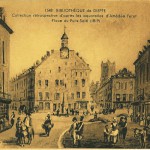
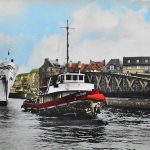
As every mariner knows, the calm green sea in our postcard match is very misleading.
In an instant winds can whip up this languid lurking mass into a fearsome monster.
Which is exactly what happened on the evening of 2 January 1899. Unfortunately the steamer ‘SS Angers’ had already left Newhaven for Dieppe.

The best cargo boat in the Line
Newspaper clippings from the time describe Angers as ‘a pretty little ship’ of 350 tons. Ferries today haven’t managed to improve on her crossing time of 4 hours at 15 knots. She was the pride, ‘the best cargo boat’ of the Western Line of France. Built by the best and launched in Granville on 21 May 1890, she was just 12 years old at the time of our tale.
Around six o’clock on the evening of 2 January 1899 Captain Fournier was at the helm with an experienced French crew as they left Newhaven. They carried 40 tonnes of cargo consisting of cloth, clothing, 36 woollen blankets and 22 hams.
Unsurprisingly for a winter crossing they were soon battling mammoth swells but the tough little ship held her course. It was around 11.30pm when the crew saw between colossal black waves the reassuring lights of Dieppe and shouted the good news down to the engine room.
Hideous forces of the sea
But the battle was not over. Close to Dieppe winds reached extraordinary speeds. They needed to approach from the west, to allow enough space to safely turn into port. Captain and crew strained to keep Angers away from the looming western jetty. Then disaster struck.
The furling line broke. Angers was unsteerable, at the mercy of violent mindless winds.
She lurched close to the jetty, was caught momentarily by the raised seabed around it then with a sickening crash pitched hard against its trusses.
Lives lost
The jetty middle was destroyed. Angers, her bow forced in to the seabed, threw chunks of her shattered stern into the water.
A wave dragged second engineer Guiemette and first mate Délorme out into the vicious sea.
For a few tiny moment of good fortune Angers was close enough to the remnants of the jetty for the crew to somehow clamber up to safety at the top. Then an explosion. Le Vot and Le Coz were trapped in the engine room, they would never be seen alive again.
Clinging to the ship and the hope that his remaining crew could be found, Captain Fournier was the last to climb up to safety.

Endless night
The whole disaster had taken less than 15 minutes. Stranded just 40 metres from land it will be seven hours before the winds calm enough for Captain Fournier and the remaining crew to be rescued.
For seven freezing hours they clung to the jetty, bruised, broken and despairing They could only watch through that endless night as shipmate Grout succumbed to his injuries and the bitter cold.

Death in the water
On the morning of 3 January 1899 as bales of cloth floated in Dieppe harbour two dead bodies washed up on the beach at Belleville-sur-Mer, four miles up the coast.
At the Western Jetty lines were propelled over to the sailors and slowly they were bought back to land.
9.45 am the Lloyd’s Agent in Dieppe telegraphed ‘Steamer Angers, Newhaven cargo-boat, is a total loss between the piers. Cargo washing ashore. Five hands drowned’.
France joins Dieppe in mourning
The twelve surviving crew were seamen Arthur Vallet, Oges and Henri Morel, Helmsman Queau, Boitout and Dubost, Menes the cook, Trupin (job described as ‘mousse’ any ideas what that may be?!), Chief Engineer Cardon, Boatswain Lesot, Mate Gaston Leber and Captain Fournier.
Most of the missing men were married and the wreck of Angers left 11 fatherless children. All of Dieppe went into mourning and news of the tragedy was reported across France and England. The families of the drowned sailors were generously compensated.
Fixing the Jetty cost 30,000 francs.

A picture of tragedy
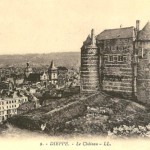
We first heard about the Angers tragedy up at Dieppe castle museum. Here a huge painting of the broken jetty by De Broutelles dominates one of the rooms. It depicts the morning after the wreck and gorgeous translucent waves still separate shipwrecked sailors from the land. Storm clouds are disappearing into the distance. Unfortunately no-one wanted to buy this 4.15m x 2.78m piece of drama and eventually the artist donated it to the town.
In Dieppe
When you are next in Dieppe pop into the castle, have a look at De Broutelles masterpiece and spare a thought for those lost souls. From the window you can see Western Jetty.
- Download a newspaper article printed 3 January 1899 (English) about the tragedy.
- Find out more about De Broutelle’s painting and have a look at it here.
Primary documentation places the launch at the FCM Le Havre works (Graville). This is corroborated by Lloyd’s Register (1892) and by contemporary press coverage such as L’Écho rochelais (28 May 1890).
Thank you so much for your blog – I truly think it is one of the 5 top blogs in Normandy! And truly, the most innovative and informative one!