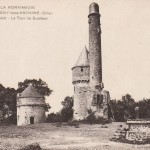
Just a mile or so from Mortagne-au-Perche, snug in the soft hills and woods of the Orne, is the tiny village of Loisail. Nothing about this hamlet of warm yellow stone houses suggests vast caverns lurk under its fields but they do.
For hundreds of years the fine limestone rock of Normandy has attracted builders. Now most of the Carrières, quarries, are forgotten. Old entrances to underground quarries are blocked for safety, others simply overgrown. This suits a particular mini beast very well.

Yellow houses of Loisail
Abandoned quarries become a home
No-one knows when Bas-Champaillaume, the Loisail quarry, was started but it was busy in the 19th century and dug by hand until five acres (the size of two international rugby pitches) of limestone was extracted. Three huge spaces over two meters high, supported by pillars of stone, are connected by 50 metres of corridors. The caves were ventilated by four chimneys that reached up to the surface, through Rouen chalk too soft for building. One chimney has collapsed but the others are still there.
After the quarrymen left came the mushroom growers in 1955. When the business closed in 1980, the caves were rarely visited. And that was just how the mini beasts liked it.
They could be seen flying back towards the entrance and chimneys at dawn after a busy night in the forests. Bats, lots and lots of bats. The French for bat is ‘chauvre-souris’ bald mice! The Carrière de Loisail is home to the largest community of chauve-souris in Normandy.

Successful conservation
During the 1980’s and 90’s lots of bats were known to be hibernating in the old caves, but they were not always popular. Blamed for spreading disease, dread, or simply gawped at by people fascinated by these strange nocturnal creatures, their humble habitat was frequently disturbed.
The naturalists took a keen interest and after a polite campaign, in 1997 the cave and chimneys were closed with strong steel bars. A couple of years later the highly respected Group Mammalogique Normand (GMN) very gently unlocked the gate and stepped in. The found their way carefully down many meters into the dark with just small helmet lamps to light their way. Then they walked quietly along the wet floored passages. To their amazement, tucked into crevices and suspended from the ceilings, they found 421 bats from many different species.

Natterers, Whiskered, Long Eared…
It was very important that they didn’t make any noise as waking hibernating bats can be fatal for them. Waking from their deep winter sleep forces bats to use essential fat stores that cannot be replenished in the cold.
The GMN now visit Loisail every year. By 2006 they were counting 1034 bats. In 2017 they counted 1350 bats from twelve species: Lesser Horseshoe Bat, Greater Horseshoe Bat, Barbastella Bat, Geoffroy’s /Notch Eared Bat, Bechstein’s Bat, Greater Mouse Eared Bat, Brandt’s Whiskered Bat, Natterer’s Bat, Daubenton’s Bat, Brown Long Eared Bat, Long Eared Bat, Grey Long Eared Bat.
The rich countryside of Loisail is a perfect location for these furry fiends. They are not interested in villages and people, these bats love the forest for their hunting. All winter they hibernate, then from springtime they emerge every evening as the sun goes down, flying up to 20km from their caves until sunrise.

Protecting the bats
If you see the bats flying out at sunset from their daytime home, or returning at dawn to dip into the chimneys back to their caves, do keep well back. These sensitive creatures are very easily unsettled with potential tragic consequences.
All bats in France are protected but their numbers suffered badly at the end of the 20th century as pesticides poisoned their prey and hedgerows providing habitats for insects were dug up. The Perche region in Normandy is a haven for them and the GMN keep an eye on 50 caves in this region. The extraordinary Carrières de Loisail were classified in 2004 and in 2015 proposed as a site of Special Conservation (SSC) FR.

Some sources
For info and events, follow the Facebook group Groupe Mammalogique Normand, an association founded in 1978, which aims to study and protect wild mammals and safeguard their habitats in Normandy.
Paper on the Loisail bat caves, pdf in French
Fancy meeting some chauvre-souris? Biotropica has a wonderful bat space to visit, with giant bats!