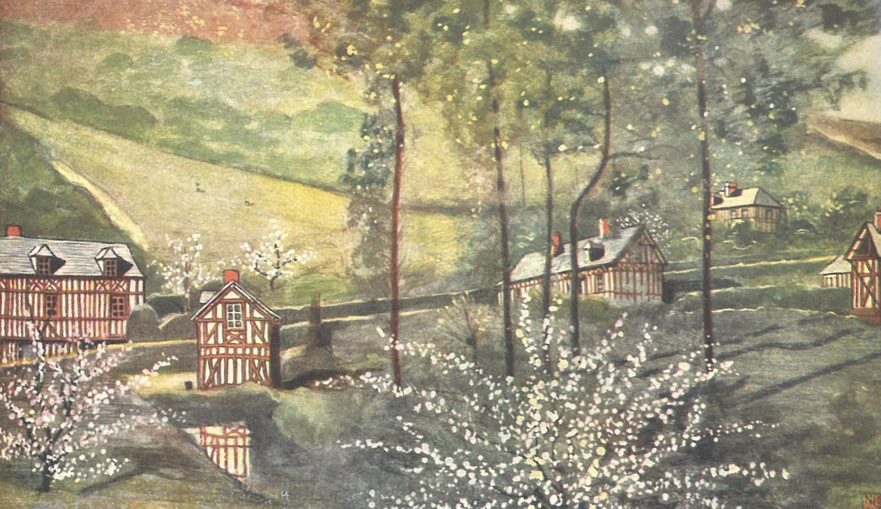
We are pleased to share a few more of Nico Jungman’s illustrations of Normandy 1905. With some honest commentary from his associate the novelist, biographer and travel writer Geraldine Mitton.

The ladies of Bayeux
If we are fortunate enough to visit the town on a Saturday, we shall see this long, narrow, cobble-paved street literally flecked with the little tight white caps, which are all that remains of the national headdress. These are not worn by very young girls, but are assumed after the first communion, when the child is supposed to have become a young woman. The only jaunty part of the headdress is the white muslin bow at the back, which bobs up and down like a rabbits scut, and when a number of women are talking together, the bobbing sometimes becomes quite laughable.
We see the same good-humoured commonplace face again and again; there is shrewdness in the keen eyes and sensible mouths, health in the smooth brown-red cheeks, and a certain comeliness notwithstanding the homely features. One feels sure that if one asked a question an intelligent answer would be given, for these women habitually use their brains as well as their hands in all their daily occupations.
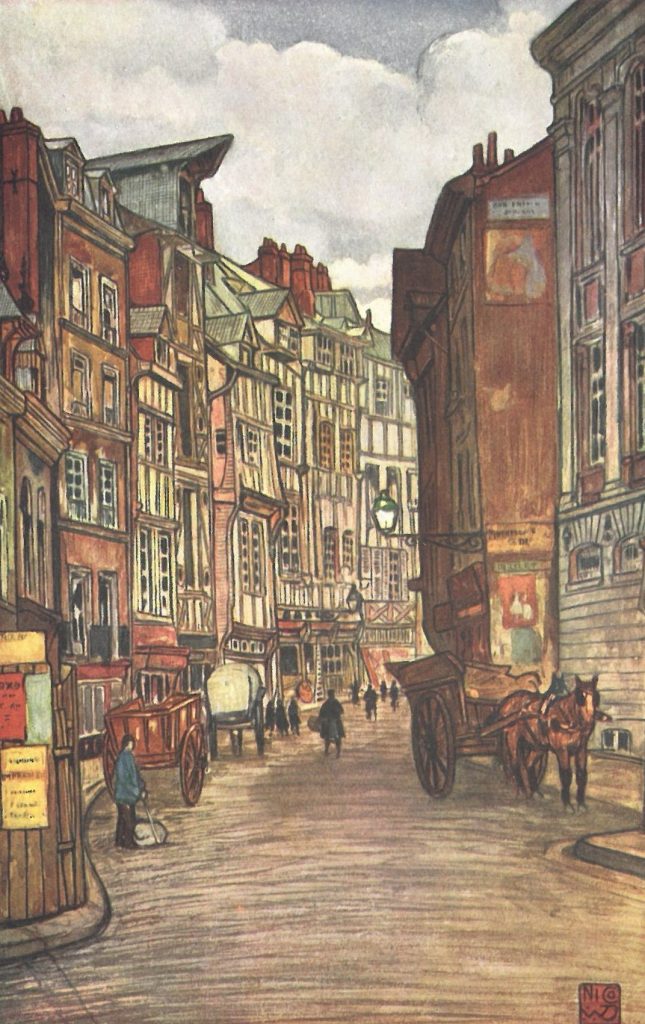
On Rouen
Such is Rouen, a city with as many facets as a jewel, each one of which contributes something to the perfect whole. We can see her as a city of magnificent churches, a city of famous Renaissance buildings, a city of narrow, crooked, winding streets, cobble-paved, and lined by mediæval timbered houses; we can see her in the light of an historic past, or as a wideawake city of the present day, with trams running along broad thoroughfares, with spacious quays and busy trade; she is a medley of the past and the present, and the one or the other is seen as it is sought – G.E.Mitton
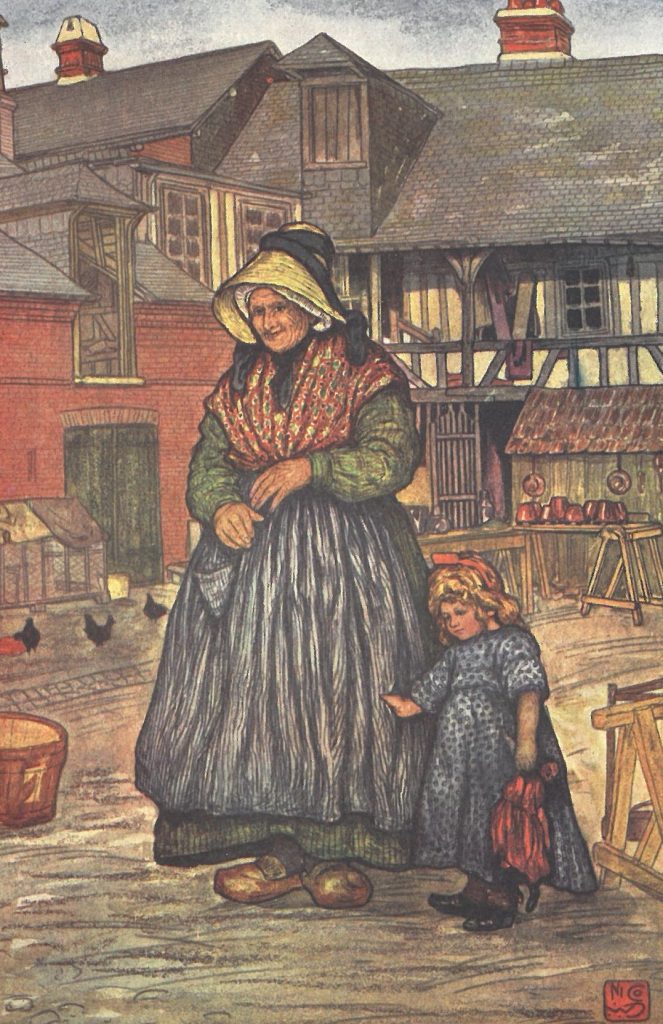
The Grandmother
I can recall one scene which could never have taken place anywhere save in Normandy. An old farmhouse with half-door, which, being opened, admitted one to an old room toned in browns of all shades, heavy beams, walls, and floor alike. A few boughs, green-encrusted, and sending up a thick smoke, lie on the open hearth.
A little old dame, of any age one likes to guess, with wizened nut-brown face encircled by a spotless close-fitting coif, is the lady of the house. Her face is one to which Rembrandt alone could have done justice, with an expression at once kindly, dignified, and shrewd. On the rough table, hacked and hewed by many a knife, are set bowls of milk strongly tasting of wood smoke. Sour cream is spread like jam on slices roughly carved from a loaf the size of a bicycle wheel, and about as hard as deal wood. The cream is very sour, and a few lumps of sugar are served out with it to be grated over it.
The old dame sits by with folded hands while the party laugh over their strange meal, but as the laughter continues she grows slightly anxious, and asks to be assured that she is not the object of it. A royal compliment in the best French at the command of the best linguist of the party chases away anxiety, and also for the moment dignity and shrewdness, leaving nothing but delight pure and simple on that dear old work-worn face – G.E.Mitton
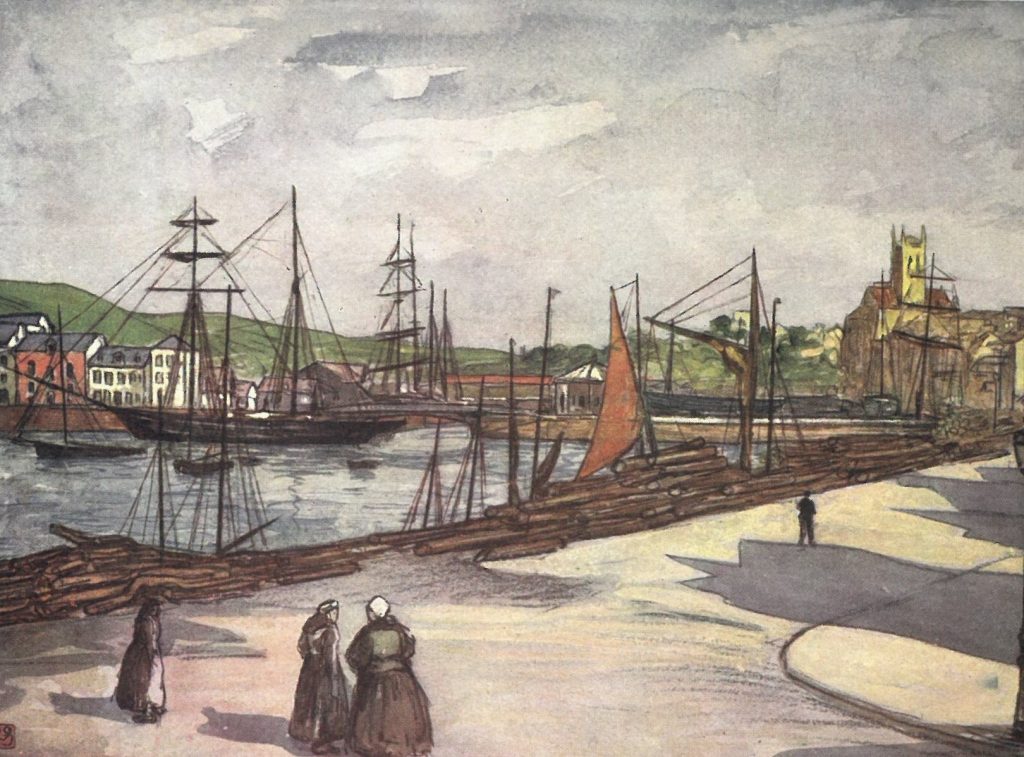
Founding Fecamp
The story goes that a case containing some of the blood of our Lord had been placed in the cleft of a fig-tree by Isaac, the nephew of Nicodemus, but in some way the stump had been cut down, and reached the sea, from whence it floated unaided all the way to Fécamp, and a well in the courtyard of a house is pointed out as the actual spot where it stranded. During a great conflagration this precious relic was lost, but an angel brought it back, saying, “Voici le prix de la redemption du monde, qui vient de Jerusalem.” Needless to say, this priceless relic drew thousands of pilgrims to the shrine at Fécamp – G.E.Mitton
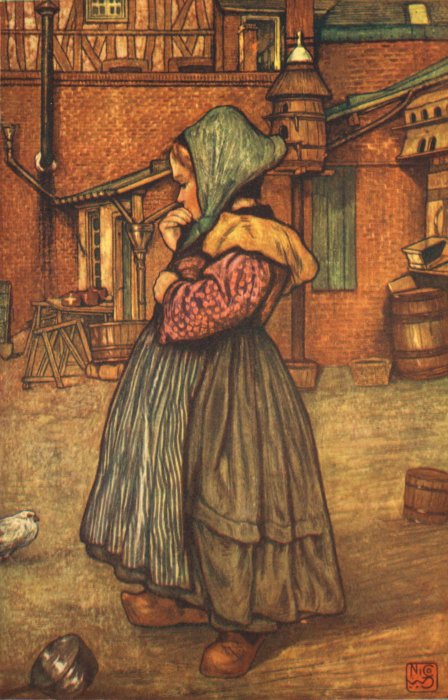
Children
The children are mostly healthy, sometimes strikingly so; and among them it is difficult to pick out any special type; bright brown eyes and sepia locks are seen side by side with hair perfectly flaxen in colour and eyes of palest watery blue; both types alike greet the “English” as a friend, for too many English are seen here to allow them to be awesome, and perhaps also the little ones learn with their earliest history there is a bond of kinship between them and these strange people who come from across the sea – G.E.Mitton
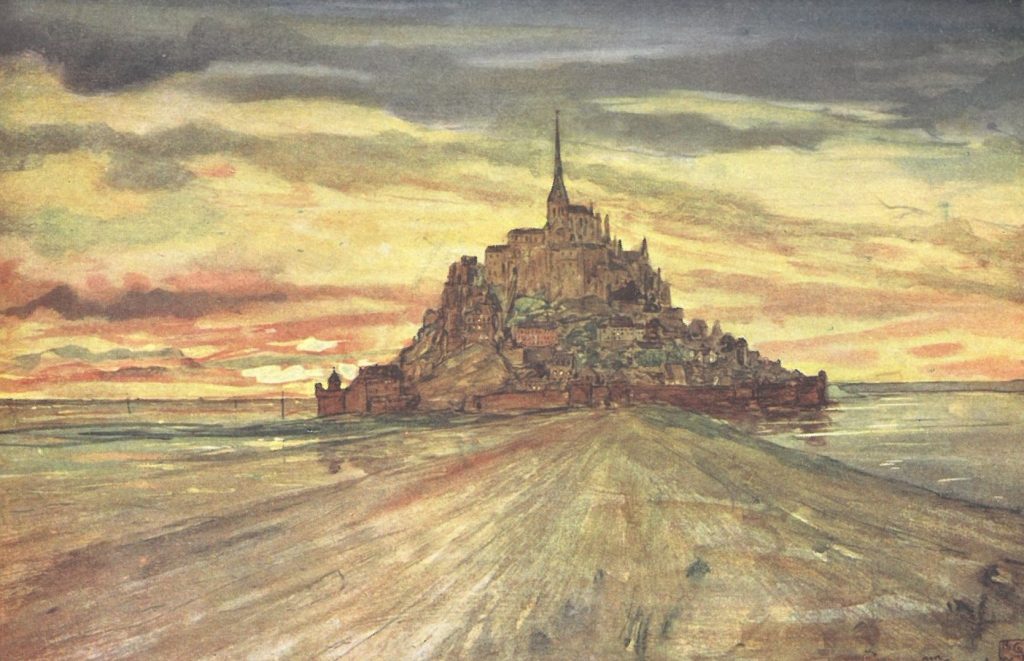
The children’s pilgrimage to Mont Saint-Michel
A strange incident is the pilgrimage of 400 children, in the middle of the fifteenth century, to the Mount, from Germany and Flanders. These children had left their homes without the consent, and in many cases against the wishes, of their parents. The sight must have been an impressive one as the little pilgrims, travel-worn and stained, saw at length their goal, and crossed the shifting sands toward it.
What became of them afterwards is not recorded, whether they returned to their homes or settled down in the country near, but the actual fact of the pilgrimage seems well attested, though the numbers taking part in it must be received with caution – G.E.Mitton
In Falaise
If one could only reverse the wheel of time and see the church as it looked at its great dedication festival, when, glittering in the smartness of work fresh from the chisel, it was dedicated in the presence of Henry the First of England!
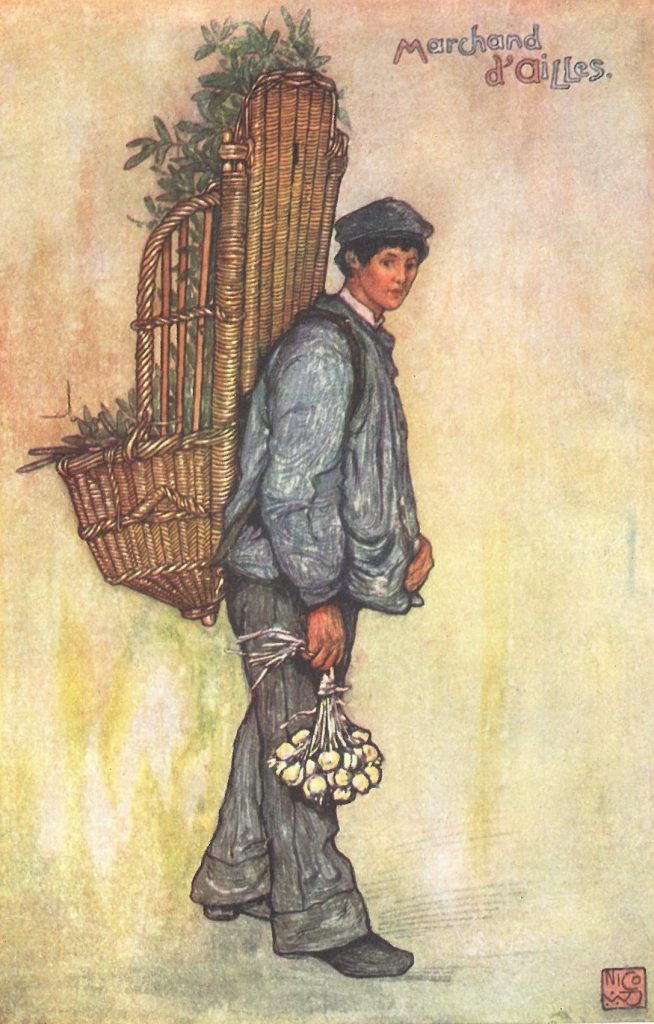
Would the workmen differ greatly in type, we wonder, from the group who now sit lazily sunning themselves on the steps? The present men, who are in blue blouses, are spare, not large of limb, with faces the colour of their own house-tiles, with sharp thin features and keen eyes? The clothing of the poor in Falaise is not so picturesque as in many parts of Normandy—the blouse is here as everywhere, but there is nothing else striking in the costume of the men, and only the older women wear caps, and those of a very simple sort; the young ones go about with heads uncovered, and hair neatly coiled up in a little top-knot, after the usual manner of the French – G.E.Mitton
Lace in Alencon
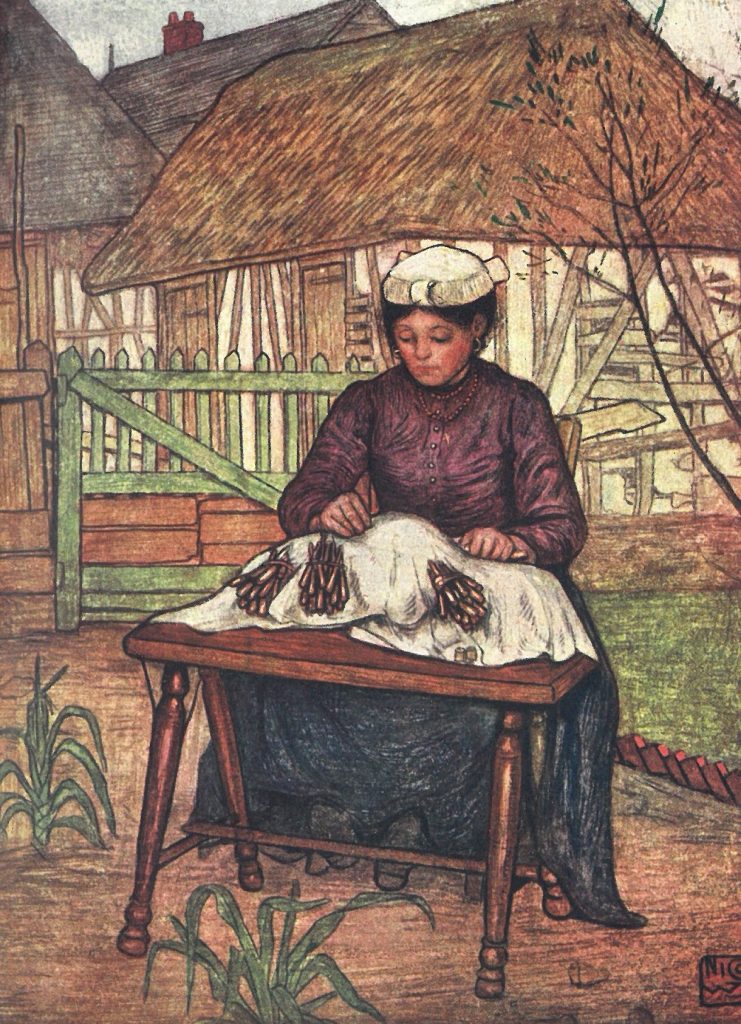
Westward is the large town of Alençon, which marks the border of Normandy in this direction. Alençon has been famous since the reign of Louis XIV for its beautiful point lace, and the industry is still carried on, though to a less extent than before. The lace is made of pure linen thread, worth £100 per lb., and is composed of ten different stitches, which are specialities done by different workers. The usual earning for this highly-skilled labour is about 1s. a day – G.E.Mitton
* * *
We will be back with more from Nico and Geraldine next year.