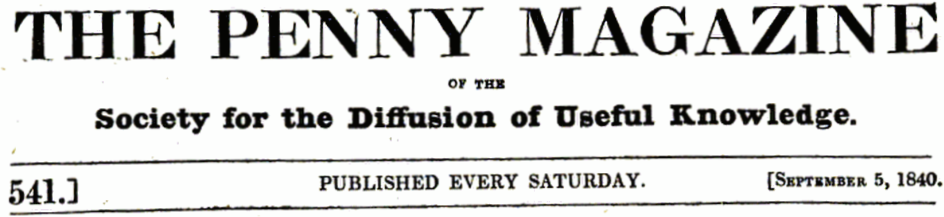
This article first appeared on 5 September 1840 in the Penny Magazine of the Society for the Diffusion of Useful Knowledge. Has Normandy changed in the last 180 years? Well not so much …
An unsuitable climate for wine
The profusion of apple and pear trees but more particularly of the former that everywhere meets the eye in the rural districts of Normandy is a matter of common observation among travellers .
The cause of these fruits being grown so much more extensively in Normandy than in most of the other provinces of France may doubtless be attributed to the unsuitable nature of its climate for the production of the grape, and the consequent necessity of supplying, in the absence of wine the ordinary beverage of the French people, cider and perry.
The culture of the apple probably varies in some respects in different parts of the country in accordance with the different habits and customs of the inhabitants, but the following method which is that pursued in the orchards of the district of Le Bocage in Lower Normandy will be found, we believe, on the whole a general application.

How to make an orchard
To a stranger, one of the most striking features of a Norman orchard is the intermediate space between the trees laid out in pasture, or planted with crops of corn hemp flax etc. It must be observed, however, that the best lands when growing corn are exempted from this double exaction. In soil of this character the trees are considered to decrease the value of the corn to at least as great an amount as they enhance the general product by their fruit.
With these preliminary observations, we now proceed to describe the general arrangement of the orchard.
The trees are planted in rows about fifteen feet apart so as to leave them all sufficiently exposed to the sun and air and so as to enable carts conveying the manure, or during harvest time the fruit, to pass freely to and fro.

The trees produce most abundantly every other year. The greatest attention is paid to them in order to discover any dead or sickly individuals, which are instantly removed and their place supplied from the nursery of young grafted trees which is always kept on the farm.
In planting the new tree a round hole is made about five feet in circumference and two in depth at the bottom of this is placed a truss of barley straw or a faggot of furze on which the root is set and the hole again carefully filled up. Palisades are then placed around the young plant, or, if that be thought unnecessary it is bound round with straw bands to prevent the sheep from rubbing against it or gnawing off the bark, or lastly the trunk is merely rubbed with lime water which some think sufficient.

Protecting apples from cows
When cows are pastured in the orchards their heads are tied down with a halter that passes between their fore legs and is attached to a surcingle, which passes round the body and which is fastened to a kind of breeching, to hinder it from coming forwards the object of this precaution is of course to prevent the animals from plucking the fruit from the trees.
So careful are the owners on this point that before the middle of August when the fruit begins to fall they remove the cattle entirely from the orchards, considering the apples injurious to them.
The growers are not very choice as to the species of apple although some of the finest sorts we have brought to our own tables come from the orchards of Normandy.

The harvest begins
The apple harvest begins about the beginning of October when men women and children sally forth with long poles to beat down the fruit with their baskets, convey it to the cart, with a little barrel of cider to cheer them during their somewhat arduous toils under blazing sun.
The apples are thus collected into heaps where they lie till the middle of November when they are carried to the cider press. The cider made from the first pressing is a very heady and strong liquor, as peasants but too frequently prove.

From abundance to brandy
In years of abundance a portion of this cider is distilled into brandy. On the second pressing a great quantity of water is added and the product is a small cider, the ordinary liquor of the labourers and domestics.
After the orchards are ploughed, cropped and with sown with grass, they remain like the other pastures of country, in that state for four years; they are then ploughed up and have a succession of crops in the order following; buckwheat, hemp or flax, then wheat or rye followed by peas or tares, barley or oats; either of the last two being sown with clover.
Even when the apple trees are thus planted in the midst of valuable crops their fruit bears a considerable proportion to the value the whole; that proportion being seldom less than fourth often a third and in some cases amounting one half.

A lesson in economics
Of the apples imported into England a large part comes from Normandy and other parts of France; the remainder we receive principally from the United States and Belgium. The amount of the imports for consumption, on an average of the three years ending with 1822, was 57,347 bushels a year; in the three years ending 1837 it had declined to 15,645. The duty was, till recently, four shillings a bushel; but by the act 1 and 2 Vict., c.113, it is made five per cent on the value which, from the 16th of August 1838, when the act came into operation, to the end of the year amounted, to 33,395L., producing a duty of 2116 L.
From:
Read the original article