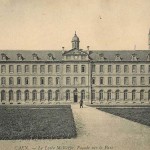
Between l’Abbaye aux Hommes and Rue Saint Pierre in Caen is Rue Écuyère, ‘street of the horsewomen’. It was named for the ladies of noble families who lived in grand houses here, but times change.
Rue Ecuyere Caen postcard match and priest photo-bomb!
After nobility came the antique sellers who for centuries made Rue Ecuyère synonymous with armoires, folderols and objets d’art. The in the 1990’s a new bar bistro, Le Vertigo, was given a licence. Le Vertigo was clearly meeting a need and others soon followed. Rue Écuyère now has a very different reputation, one considerably more popular with students of the town.
Rue Écuyère is officially the thirstiest street in Normandy and fifth thirstiest street in all of France.
Bistrography of France
This achievement has been calculated using the government’s Siren database of companies and institutions, and is based on density – on average you will stumble upon bar in Rue Écuyère every 19 meters.
Data lover Mathieu Garnier is responsible for merrily crunching the numbers and creating this bistrography of France. First prize went to rue Saint-Michel in Rennes and its astonishing bistro every 7 meters. In a straight line – calculations do not allow for the cheery drinkers’ wobble.
While rue Écuyère is less than 250 meters long, it is home to ten vibrant drinking establishments, eight of them within 100 meters.
Infamous Caen cocktail
Just a few steps from Le Vertigo is Bar le 23, birthplace of the infamous Caen cocktail ‘l’embuscade’…The Ambush! The Ambush is an explosive blend of lager, a splosh of fruity syrup, white wine and calvados first thrown together by an irresponsible hand in the 1990’s. This effervescent refreshment became such a hit it spread across Normandy, to Paris and can now be found far into a delighted Europe.
Traditionally made for sharing in pitchers, the recipe is roughly:
2 parts Calvados
3 parts white wine
5 parts beer (lager to the Brits)
A splosh of pomegranate syrup or blackcurrant
And if you are feeling fancy, a drizzle of citron syrup
Combine all ingredients in a pitcher, stir and share!
Fickle hearts
The street was paved in 2009 and the little tables and chairs in front of each bar bistro spread out a little further.
Of course student favour is fickle. In the mid-60s they crowded into bars along Boulevard Maréchal-Leclerc; les Touristes, les Caennais and le Drugstore Saint-Pierre. In the 1970s they gravitated towards rue du Gaillon then home to five bars. Now they, along with the office workers and shop people of Caen, favour Rue Écuyère.
Antique store on Rue Ecuyere
Investing in drawers
For the antique dealers the news is not so good. Just six survive, high rents pushing out tenants and those that own their shops are pessimistic. They say the public is less interested in old furniture. Thomas Ceyssel, antique dealer in the street says “Today people no longer invest in a chest of drawers“. The estate agents complain apartments prices have dropped along the road.
Antiquités Fontaine on Rue Ecuyere
Buoyant
But for the bars along Rue Écuyère the mood is buoyant. Convivial with standing room only, conversation ranges from the political to the puerile and from high art to low humour, exactly as it should be. When the students go home each summer, tourists cheerfully fill their place.
Perhaps we will see you there;- in La tomate bleu, Bar Le 23, Ecto Bar, El Mojito, La Rhumba, L’Endroit, La Tour Solidor, Le Broc Café or Le Vertigo… Hic!
Anyone who has read our advice for what to do when it rains in Normandy will know touring the makers of wonderful calvados, pommeau and cider is very high on the list. But what to expect? Here are some notes from our visit to the comte Louis de Lauriston cellars, near Domfront. Didier Thomas welcomed…
We started this blog to answer the question 'is there more to Normandy than Monet, WW2, Calvados and Cheese?' and are still enjoying looking for the answer. Along the way we have come up with five sure fire ways to miss out on some of the best that Normandy has to offer, so don't make…
This sad little postcard was 1 euro at the Honfleur outdoor flea market just a few months ago. All we can be certain of is that one of the signs says 'Caen' and the other 'No Entry'. Judging by the desolation this is Normandy in 1944. Can you help? We would love to be able…
This week our match is 73 years out of date. The early postcards reveal a world now lost. They are matched with photos taken in the summer of 1944, in WW2. The wartime quality of the photography is not sharp, but the story is clear. The battle for Caen lasted just under two months and…
First published here 2017 During the Second World War, news, particularly good news was shared quickly across the Allied world. While each battle has been studied in detail by historians over the years, at the time newspapers reported them hurriedly as steps towards freedom. Reading those old papers today we are for a moment transported…
Setting the scene It is August, 1789. The French Revolution, which started idealistically enough with the formation of a National Assembly on 17 June to balance royal power, has become rather less polite as the Bastille is stormed on 14 July. This political drama follows months of hardship for the people of France as appalling…
A simple postcard match silently reveals the carnage of 1944 without saying a word. See how Rue Saint Jean has changed? Brillaud Laujardière was the chief architect responsible for Caen’s reconstruction after WW2. His forward looking design blew fresh air into once narrow streets, planned for a world with cars and around our little church…
This simple postcard of an old church took us to the outskirts of a quiet village near Caen and into the centre of a war. Inside are the church sit pews from the 8th century and along the walls are paintings from the 13th. Perhaps the survival of these blessed remnants gave hope to a…
There have been a lot of changes for this old building and something quite spectacular is now missing... There have probably been dwellings on this piece of land by the Orne river since dwellings took over from caves and nice hollow trees. We do know a ‘Manor Talbotière’ stood here and was given by John…
First published 2016/05/14 We discovered this moment in Caen WW2 history reading the marvelous magazine Patrimone Normand ‘Normandy Heritage’ who have very kindly allowed us to use some of their photographs. Caen in the spring of 1944 One spring evening in 1944 Colbert Marie, age 17, left his boxing club with friends the Boutrios brothers;…