Victor Alfred Lundy was 21 years old when he was shipped out to Europe, in August 1944. D-Day and the army had changed his plans from architecture, to the infantry.
Enlisting
Victor enlisted in the army in December of 1941, the day after the bomb was dropped on Pearl Harbour. He was accepted into the Army Specialized Training Program (ASTP), established to prepare officers who would be responsible for the reconstruction of war torn Europe. Victor was sent to the University of Maine and trained for eight months. The ASTP was then abandoned and all soldiers in the program became infantry.
The sketchbooks
Victor kept sketch books during his training in Fort Jackson, North Carolina and later when he arrived in Europe. His drawings during training in the USA are often of men resting, playing cards and waiting for their war to start. Once in England, then France, it’s a different story. He recalled years later:
“August 25th 1944, there’s a sketch which says ‘overseas at last,’ and since then, I realized we were part of a very significant occasion…this is real.”
‘Overseas at last’ drawing by Victor Lundy
Victor arrived in France on 7 September 1944. Here are a selection of Victor’s Normandy sketches, drawn at the end of days and in short breaks, revealing an American soldier’s first impression of France, in WW2.
Arriving at Cherbourg
‘Home is far away now!’
Soldiers on landing craft
‘Sea-plane hangar wrecked by Germans at Cherbourg’ 7 September 1944
‘Ready to move by truck to our first camp in France’
‘2 1/2 kilometers from Montebourg 10 minute break’
‘French farmer, St. Martin d’Audeville’
‘House where Kane & I got the roast chicken & cognac’
‘Café where the 2 French girls bought us 4 bottles of cider, Quinéville’
‘Camouflaged German gun position, beach in Quinéville’
‘Beach & barbed wire entanglement at Quinéville’
‘Part of the Atlantic Wall, Quinéville 6 men from L Co. hurt here, 6 killed’
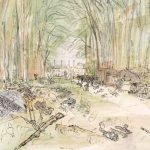
Chateau de Sully, near Bayeux, June 1944 by Anthony Gross First published here 2017 Although photographs remember a moment, an event, war artists see the emotion in a war; how people live within it, the minutiae of daily life as they prepare, wait, fight, suffer and celebrate. Faced with the vastness of war, war artists…
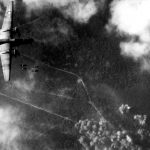
This is a photograph of a A-20G bomber of the 645th Bombardment Squadron, 410th Bombardment Group, 97th Combat Bombardment Wing, IX Bomber Command releasing its bomb load over the Andaines forest, in the Orne. During WW2 the forest hid fuel and ammunition stores for the German 7th Army. Allies bombed the forest on 13 and…
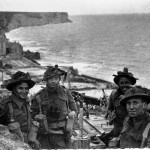
Up on the hill above Arromanches-les-Bains we looked down on the bay that became known as Gold Beach on 6 June 1944. We were matching a postcard of four survivors, soldiers who had arrived on D-Day. We know the photo was taken shorty after D-Day as the Mulberry Harbours, essential for landing provisions, are not yet…
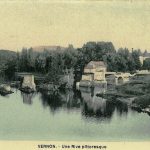
As we stood on the latest Vernon bridge (there have been many) in Eure, we matched our postcard with no idea of the dramas this idyllic scene had witnessed. An online search revealed a vast library of WW2 pictures of soldiers. Then we discovered just a suggestion of a lesser known story that shocked and…
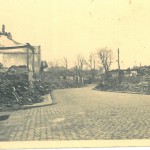
This week our match is 73 years out of date. The early postcards reveal a world now lost. They are matched with photos taken in the summer of 1944, in WW2. The wartime quality of the photography is not sharp, but the story is clear. The battle for Caen lasted just under two months and…
This sad little postcard was 1 euro at the Honfleur outdoor flea market just a few months ago. All we can be certain of is that one of the signs says 'Caen' and the other 'No Entry'. Judging by the desolation this is Normandy in 1944. Can you help? We would love to be able…
We have been amazed and delighted by the amount of interest Normandy Then and Now has received since launching at the beginning of 2014, thank you! Looking at the numbers (thanks to Ian our sponsor!) we have discovered your 5 favourite posts of the year. From the top these are: A Frenchman’s home is his castle,…


Wonderful site with lots of neat history and art-thanks for sharing! Best regards, JS
Looking for information about Billie Lee Bishop (my uncle) who was killed via anti-personnel mine, October 15, 1944 near Les Pieux, France.