Quietly crumbling into the sea, in amongst soft dunes isolated by marshland, is the Batterie Blankenese de Néville-sur-Mer. A few miles east of Cherbourg this is not a famous WW2 heritage site, but still a poignant reminder of when Normandy was occupied by an unwelcome enemy.
Blankenese, late June 1944
Then
Here, from 1943 the Kreigsmarine, German navy, defended Cherbourg with British anti-aircraft Vickers guns seized in 1940 from the Channel Islands, along with captured French guns.
When the Battery came under heavy attack from the US navy on 18 June 1944, the short firing distance of the guns – 12km for the Vickers, 20km for the French guns – rendered them useless. Before evacuating to Cherbourg the Blankenese sailors blew up what they could of the site.
The 24th Cavalry Reconnaissance Squadron, 4th Cavalry Group finished the job for them when they liberated nearby Néville-sur-Mer. A declassified Historical Report for the 24th suggests this was probably 22 June 1944 when they were between Barfleur and Cherbourg and ‘in contact with the enemy line of resistance, which was a series of fortified areas’. If you have more information we will be please to update this page.
Now
Since the war this coastline has shifted and now high tide washes over many of the buildings. Blankenese was built closer to the sea than many other Atlantic Wall gun Batteries, a hallmark of the Kreigsmarine.
The sea and winter storms are slowly breaking up the old concrete and these buildings change constantly, further away from their murderous past to be ineffectual, if sculptural, ruins.
Google view, linked to Google map of Batterie Blankenese de Néville-sur-Mer, in the Manche, Normandy
Visit
Our visit was in September 2016. The site is in open countryside with free parking down a bumpy track. Caution is advised if you find anything that looks like a bullet, live ammunition is frequently found in the area.
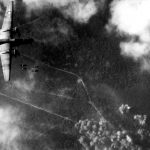
This is a photograph of a A-20G bomber of the 645th Bombardment Squadron, 410th Bombardment Group, 97th Combat Bombardment Wing, IX Bomber Command releasing its bomb load over the Andaines forest, in the Orne. During WW2 the forest hid fuel and ammunition stores for the German 7th Army. Allies bombed the forest on 13 and…
First published here 2015 Our new series of day trips for Normandy fans begins with an emotional visit to the D-Day landing beaches. This is a long day, but one that will stay with you forever. Best to plan ahead and have drinks, snacks and a packed lunch with you. Useful museum and memorial links…
Or, how the Noireau river got a little piece of the Mulberry Harbour for a bridge... The Résistance in action In June 1944 a few days after the Allies landed on Normandy’s beaches, a few members of the Résistance quietly met in the small village of Le Pont Grat, in enemy occupied Vallée de la…
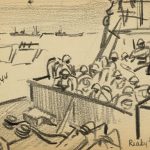
Victor Alfred Lundy was 21 years old when he was shipped out to Europe, in August 1944. D-Day and the army had changed his plans from architecture, to the infantry. Enlisting Victor enlisted in the army in December of 1941, the day after the bomb was dropped on Pearl Harbour. He was accepted into the Army Specialized…
First published here 2018 In the summer of 1943, a middle aged Frenchman in blue overalls pushed a wheelbarrow past German sentries into a construction site at Bonnetot, between Dieppe and Rouen in Normandy. The man, Michel Hollard, did not look extraordinary but he was. Audacious and brave, Michel’s actions that day would go on…
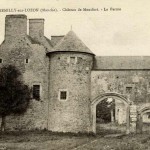
First published February 2015 Ever wanted some peace and quiet? Remilly-sur-Lozon in the Manche has a wiki entry that simply states ‘Remilly-sur-Lozon is a commune in the Manche department in Normandy in north-western France.’ No paragraphs of history reaching back to William the Conqueror, no D-Day memories. Just a note to say ‘yes it exists’. Can anywhere in Normandy really be that nondescript? From…
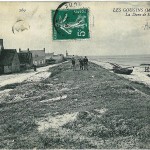
First published February 15, 2014 On our way to the vast beaches by Les Gougins in Manche, just north of Utah Beach, we took a small detour to pay our respects in Angoville-au-Plain. Hidden down ancient lanes long sunk into the Normandy countryside, Angoville is reached by a single track road. This is a hamlet, not…
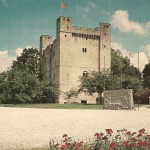
It’s often the simplest postcards that reveal the most shocking stories. This is true of Chambois. First published here 2014 Our postcard shows the old keep or ‘donjon’, once part of a medieval fortress that now houses nothing more ferocious than a loft of lethargic pigeons. The photo and the postcard do not match as…
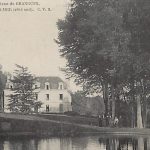
First published June 2018 Our postcard is impossible to match as this is a private residence, however the story of the Château de Grangues does not need a matching photograph, just to be remembered. The Château is set discretely back from the road in parkland, just a few kilometres from the seaside town of Cabourg.…