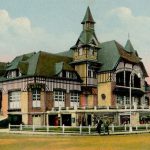
Chateau de Sully, near Bayeux, June 1944 by Anthony Gross
First published here 2017
Although photographs remember a moment, an event, war artists see the emotion in a war; how people live within it, the minutiae of daily life as they prepare, wait, fight, suffer and celebrate. Faced with the vastness of war, war artists see the ‘ordinary’ men and women within it.
Anthony Gross
Artist Anthony Gross landed on Gold Beech at 2pm on D-Day, 6 June 1944 with the 50th (Northumbrian) Division.
He waded to shore holding paper and paints above his head and spent his first night in a slit trench on the beach. Moving inland, Anthony travelled through the ‘Bocage’, saw Cherbourg, the devastation of Bayeux and Caen, before following the Allied armies into Paris.
Anthony Gross’ paintings record a well known time, but with the unique view of the artist. His paintings of soldiers somehow show in their faces what they have seen in that terrible war.
Anthony Gross’ watercolours are held by the Tate Gallery and the Imperial War Museum in London. Here are a few paintings from his journey across Normandy.
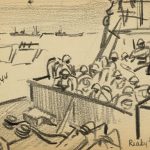
Jig Beach looking towards Le Hamel, 7th June 1944, by Anthony Gross151 Brigade Rear Headquarters in the Chateau De Briqueville, Gueron, Normandy 10th June 1944Dli Main Hq at Damigny, 11th June 1944Jerusalem Cross Roads, 13th June 1944The Fall of Cherbourg – the quayside and the Fort du Roule. 28th June 1944Observation Post on Mount Pincon – the Gunners are directing fire on to an enemy strong point in the village of St Pierre, 10th August 19446 Battalion, Green Howards, Hq Wireless Section in the Bocage, with Private W Wright, ‘eisenhower’ the Rabbit, Corporal T Murray and Sergeant L SmithCarrier Platoon of 7 Battalion, Green Howards, near Longraye, Normandy, with Sergeant M W pinkley, Lieutenant L W Hardbottle and Captain W MurrayThe 50th (Northumbrian) Division, 1944- Rear Hq in the Grounds of the Chateau of St Andre, Normandy, with Lieutenant-Colonel T S Black ; Major W H L Urton, MBE ; Lieutenant-Colonel R G Gibb, OBE ; Lieutenant-Colonel G W Fenton, MB
‘This artist captured D-Day in stunning watercolours‘ article by Matt Brosnan, Imperial War Museum (with images).
Victor Alfred Lundy was 21 years old when he was shipped out to Europe, in August 1944. D-Day and the army had changed his plans from architecture, to the infantry. Enlisting Victor enlisted in the army in December of 1941, the day after the bomb was dropped on Pearl Harbour. He was accepted into the Army Specialized…
Our guest blogger is Gordon Cochrane Home. An artist, traveller and writer, Gordon visited Normandy at the beginning of the 20th century. This week Gordon is sharing illustrations of chateau Gaillard, Saint-Lô, Ouistreham, Domfront, Vire, Rouen and a Normandy farm. These paintings first appeared in his book 'Normandy Illustrated, the Scenery & Romance Of Its Ancient Towns'…
There is a famous black and white film, produced by Darryl F. Zanuck with the best intentions of exposing the horror and bravery of war. He had determined to make a revolutionary, realistic movie to parade before audiences who were just boys and girls during WW2. The film would be about 6 June 1944, it is called The Longest…


_Division,_1944-_Rear_Hq_in_the_Grounds_of_the_Chateau_of_St_Andre,_Normandy,_with_Lieutenant-colonel_T_S_black_;_Major_W_H_L_Urton,_Mbe_;_Lieutenant-colonel_R_G_Gibb,_Obe_;_Lieutenant-colonel_G_W_Art.IWMARTLD4482.jpg)